
Tagged: bangladesh

Tea workers in Bangladesh rally and get organized!
The Tea Workers’ Trade Union Center (TWTUC) commemorated its 1st National Conference at the Moulvibazar District Council Auditorium in Sreemangal on June 29th, 2025 with hundreds of workers coming together.
The conference was announced by comrades of TWTUC with the following words:
Revolutionary greetings from the tea workers of Bangladesh. For generations, tea workers have endured systemic discrimination and exploitation. In response, we have been organizing sustained movements and struggles to secure our fundamental rights and dignity. Today, we express our heartfelt solidarity with tea workers across the world. From continent to continent, working people face similar patterns of exploitation, marginalization, and repression. Our struggle, therefore, is not confined within national borders—it is part of the broader fight for international working-class unity and justice.
We believe that the liberation of the working class cannot happen in isolation. True freedom is only possible through the unity and solidarity of all oppressed, exploited, and struggling workers across the globe. As part of our ongoing movement, we are pleased to announce the 1st National Conference and Mass Rally of the Tea Workers’ Trade Union Centre.

TWTUC released the this 10-point charter of demands:
1) Wages
a) Set the minimum daily wage at 600 BDT*, preserving all current benefits (including rations, housing, and healthcare). Overtime must be compensated at double rate. For additional leaf picking, a payment of 12 BDT per kg must be ensured. Manipulation in weight measurements must stop—replace analog scales with digital ones visible to workers. An annual 10% wage increment must be guaranteed. The anti-worker Gazette published on 1 August 2023 must be repealed.
b) By labor law, provide all workers with Provident Fund, Gratuity, and 5% of company profits under Section 234 of the Bangladesh Labor Act, 2006. As per the 2016 agreement, retired workers must receive a pension equal to 1.5 months’ wages per year worked. In case of workplace death or disability, full lifetime earnings must be compensated.
c) Provide two annual festival bonuses equivalent to a full month’s wage, and one additional incentive bonus—these must not be attendance-based.
d) Enforce casual leave (10 days/year) and earned leave (1 day for every 18 working days) as per labor law.
* 600 BDT equal approx. 4.20 EUR / 4.93 USD. The current daily wage stands at 168 BDT and a new phase of labour struggles for higher wages could be expected later this year
2) Rations
Provide full family rations weekly, including rice, flour, lentils, oil, sugar/jiggery, soap, tea leaves, and kerosene. End all unjust ration deductions for agricultural land use. Sanitation infrastructure (toilets, etc.) must be provided per Section 59 of the Labor Act.
3) Land Rights
Grant legal ownership of residential and cultivated land to tea workers. Distribute unused land among unemployed tea worker youth.
4) Education
Officially recognize tea workers’ ethnic identity, language, and culture. Establish government primary schools in every tea garden. Provide primary education in workers’ native languages. Establish specialized secondary schools, colleges, technical institutes, and cultural academies in every valley.
5) Healthcare
Ensure qualified MBBS doctors, functional community clinics, and adequate medicine supplies in every garden. Provide safety equipment against pesticide-related health hazards.
Install deep tube wells and one tube well per 20 families for safe drinking water. Each garden must have at least one ambulance.
6) Women’s Rights
Grant 6 months paid maternity leave to female tea workers. Provide 2 days of paid menstrual leave per month. Supply free sanitary pads through community clinics. Ensure safe and hygienic delivery facilities, nutrition, medicine, and vaccines. Allocate raincoats to all female workers each monsoon. Build separate toilets for women in each section. Take effective measures to eliminate child marriage and violence against women in tea gardens.
7) Job Security & Employment
Regularize the employment of all temporary workers. Provide job opportunities for unemployed tea workers. Eliminate child labor in gardens. Establish quota reservations in employment for workers’ children. Employ educated female workers in staff positions.
8) Recognition of Historical Struggles
Declare May 20—the day of the historic “Cholo Mulluke” tea worker uprising—as National Tea Workers Day, with paid leave. Identify and honor tea worker freedom fighters and martyrs from the Liberation War. Preserve all related memorial sites.
9) Local Governance
Form union councils (Union Parishads) based on tea gardens. Utilize all opportunities to form sub-districts (upazilas) in tea-producing regions.
10) Legal & Organizational Rights
Repeal all anti-worker laws in the tea industry. Ensure the right to free association and trade union formation. Fully implement the Labor Act in tea gardens. Establish a Minimum Wage Board specific to the tea industry. Set up a permanent Labor Court in Sreemangal, and ensure resolution of all cases within 90 days.
The Daily Star reports on the conference:
A procession followed, drawing hundreds of tea workers and students from across Sylhet, Moulvibazar, Habiganj, and Sreemangal. They carried banners, festoons, and chanted slogans, demanding recognition of their rights and fulfilment of their long-standing demands. […]
Organisers said the conference marks the beginning of a broader movement aimed at mobilising the collective strength of tea workers in their fight for dignity and justice.


Several unions and comrades in Bangladesh and internationally expressed their support and solidarity with the tea workers ahead of the TWTUC conference, such as GABRIELA, the broadest alliance of Filipino women, and the International Confederation of Labour (ICL-CIT). All greetings were published on the TWTUC facebook page.


Uprising against an autocratic state: The present, past and future of Bangladesh

☆ deutsch ☆ español ☆ português ☆
As I am writing this statement, I don’t know the whereabouts of most of my comrades who participated in the ongoing protest of students in Bangladesh. All I know is that they were on the streets, trying to fight back against the police, against the fascist goons of the autocratic party. As only people from some parts of Bangladesh have regained internet access after five days of state ordered nationwide internet blackout, connecting to people back home from abroad has been tough. As new photos and news unveil the unprecedented violence of the police, where they are torturing and killing unarmed people, I go through feelings of anguish and anger. I think about my comrades back in the country, but it’s not only about them, it’s about the entire country. I only know that my comrades are part of the resistance where thousands of others joined, where people are protesting against the fascist and autocratic state, which has killed at least 197 people, detained hundreds, and left thousands injured in the hospitals.
All of this started with a peaceful protest by the students and government job seekers in demand for quota reformation. The quota system in Bangladesh reserves 30% of the jobs for the descendants of the freedom fighters who took part in the liberation war against Pakistan in 1971. This 30% quota leaves most general people with very little chance to secure a government job. The problem of unemployment and recent economic crises have made government jobs very competitive, and most people consider this 30% quota discriminatory and unfair. Even though the ruling party describes the quota system as a way to show respect to the family of freedom fighters, in reality, the ruling party used it to have an obedient group of people in bureaucracy.
First of all, the liberation war of Bangladesh in 1971 against Pakistan was a people’s war; people from all walks of life helped the freedom fighters through various means. Second, many of the poor freedom fighters belonging to the working class couldn’t manage any certificate of being freedom fighters. Third, there have been claims of corruption and nepotism in issuing freedom fighter certificates by the ruling party. So, this 30% quota allows the government to consolidate their power. Furthermore, reserving 30 % of government jobs for the third generation of freedom fighters, which is less than 5% of the population, stands against the central ethos of the liberation war: equality, freedom, and justice.
As anarchists, we supported the just demand of the students. Still, we also believed that mere quota reformation could not solve the problem of the capitalist economy maintained by an autocratic ruling party. However, things escalated when the government responded to the peaceful protest with unparallel violence from police and their fascist goons. The state violence against protesters completely transformed the current movement. Before, moving to this part of the current stage of the movement, it’s necessary to describe the current political scenario of Bangladesh.
For the past 16 years, Bangladesh has been ruled by Prime Minister Sheikha Hasina and her party, Awami League. Even though they first came to power by gaining an electoral majority, they soon became an autocratic party and retained state power through three rigged or staged general elections. Furthermore, Sheikh Hasina and her party boast of being the only party in favor of the spirit of liberation war. In reality, they have appropriated the spirit and gains of liberation war from the masses. They have tried to portray the liberation war exclusively from a nationalist perspective while it was a peoples’ war led by aspiration for equality, freedom and justice. Post-independence, the class characteristics of the state did not transform, as one group of domestic rulers just replaced another group of foreign rulers. The state apparatus and legal systems also continued to carry the legacy of the Pakistani and British colonial ruling system. Awami league in their last 16 years of rule has utilized all of these organs of the state ruling system to wipe out opposing views. They have justified it by using their nationalistic rhetoric and tagging everyone else as anti-liberation force.

Even though Bangladesh has achieved high GDP growth in the past decade, it mainly came through the expense of cheap labor in readymade garment sectors and exporting of low skilled labor in middle east. Both of these groups have suffered from inhumane working conditions. While the collapse of Rana Plaza, which killed 1134 people in 2013, managed to gain coverage in international media, other killings from fire and police crackdown have gone unnoticed. The government has cracked down on many labor unions (including the abduction of a union leader), took control of most of the other labor unions, and banned union activity in some areas. Even in the last year, garment workers were killed and arrested for demanding an increase in minimum wage. Recently, Bangladesh’s economy has been facing a crisis as its short-term development strategy financed by borrowing money is having repercussions. Imperialist and expansionist powers such as the United States, China, and India consider Bangladesh to be a geopolitical region of interest. India, the country that shares borders with Bangladesh, has been most influential in the politics of Bangladesh as they offer the government “legitimacy” to the West in exchange for contracts that only satisfy the interest of the Indian government. Although the ruling party has managed to be reelected for another term without a fair or inclusive election, people are suffering from unemployment, inflation, inequality, and oppression by the ruling party.
The current economic condition and lack of fundamental human rights have created mass discontent among the people of Bangladesh, especially the youth. However, the government, ruled by Hasina, after the recent re-election, considered it to be virtually unchallenged in continuing its regime of corruption and exploitation. So, when the students started peaceful protests for a fair quota system that would prioritize merit, the ruling party resorted to violence. First, they employed the students league, the fascist foot soldiers of the ruling fascist party. They mercilessly beat students and protesters and even attacked them in hospitals. However, this time, the students soon created resistance and managed to regain control of the dormitories from this fascist student wing for the first time in 16 years of Awami rule. Then, the government called the police force to stop the protest. The police used brutal measure and started killing protesters on July 16. That failed to stop the resistance, and it only grew in numbers. The coordinators of the movement called for a complete shutdown of all public activities in the following days.
On July 18, the police and ruling party goons used unforeseen levels of violence as they attacked students protesting inside and in front of universities and high schools. However, the students showed immense courage and tried to fight back. They organized themselves, coordinated with each other and used their limited resources to hit back against the state violence. In different areas, the foot soldiers of the regime and the police force were compelled to leave the area as the protesters fought back. The government also multiplied violence in response and went on a killing spree. By the afternoon of July 18, confirmed news of the killing of many University and high school students were circulated on social media. Mass people started joining the movement, and violent clashes took place between them and armed forces (and ruling party goons). Later that day, the government completely blocked internet access to the entire country to quell the protest. That did not succeed, and protesters continued the resistance the next day, July 19.
Different political party members also joined the movement at this point, but the participation of the mass people and students continued. The armed forces shot and killed at least 70 protesters that day. Most of the people killed were students, but photographer, rickshaw puller, transportations workers were also killed. 2 policemen were also killed by the protesters during the clash. From Friday night, the government enacted a curfew and employed the military.
However, clashes and death were also reported on Saturday.
As only some of Bangladesh regained internet access after 5 days of internet blackout from government, it’s difficult to obtain reliable news. The media operating within the country is heavily controlled by the government. The government is also not providing any information on the number of deaths, nor is it allowing medical officials to do so. There have been claims of police seizing death registers from hospitals. According to one leading newspaper in Bangladesh, at least 197 people have been killed in the ongoing protest. However, the actual number is estimated to be way higher. People and news reporters state that they haven’t witnessed such a massive scale of violence in years. Photos and videos are emerging where we can see piles of dead bodies lying on the floor of a hospital, the police continuously shooting at unarmed people from point-blank range. As reported by DW news, UN vehicles for peacekeeping missions have also been used by the armed forces to attack protesters in Bangladesh.
Aside from resistance on the ground, the youth are rejecting and tearing down every narrative of the fascistic party and the authoritarian state. The mass people of Bangladesh have shown immense solidarity with the student movement as they view it as a rightful resistance against the autocratic leader Sheikh Hasina. Local people provided free food and shelter and helped the injured people to reach hospitals. People have expressed mass disobedience and non-cooperation with the state during the movement. The working-class people have shown incredible solidarity with the students in the protest. They have actively supported them and, in some areas, participated with the students. During the movement, the students used various tactics of direct action and mutual aid that helped them to resist successfully.
On July 21, the supreme court gave a verdict in favor of quota reform. Even though the suggested distribution reduces the quota for freedom fighters’ descendants which the protesters demanded, it also reduces the quota for disadvantaged groups of citizens, which is unfair.
Furthermore, after the mass killings in the past week, the situation has gone well past quota reformation, and a large number of people now demand the resignation of the Prime minister Sheikh Hasina. However, through controlling media, communication, and excessive force, the government has retained some ground. The police have detained hundreds of students. One of the coordinators was also abducted and tortured by the armed forces. The government is trying to portray that things are getting normal, and soon they will probably have to resume internet connection in the entire country and bring an end to the curfew as businesses are going through heavy losses due to shut down. When the internet gets back, the coordinators and protesters will have to face a tough battle against an unmasked dictatorship that has blood of hundreds of people in its hand.
I don’t think that Bangladesh can go back to being normal again after this killing spree and violence of the ruling party. The people of Bangladesh must decide if totalitarianism by a fascist party will be the fate of the country or will people regain their power. The movement, which started as a protest for fair opportunity in jobs, has transformed into a mass uprising against fascist Hasina’s rule and state violence where the people of Bangladesh are expressing their urge to live with freedom, rights, and dignity. However, to reach that destiny, we need a democratic transformation of the state, we need to dismantle elite armed force which commits extrajudicial killing, and we need to restructure every institution so that nobody ever can gain the power to commit such atrocities. We need to throw away neo-liberal policies and move towards an economy for the people and workers, not for the capitalist class. However, for all of this to happen, we need a strong working-class movement and civil rights movement. So far, the people and society have shown incredible resistance against state violence. The resistance marks a new beginning for the struggle towards a more equal, just, and free Bangladesh. The future is uncertain but if this movement shows anything, it has shown that organized people fighting for just cause can show unthinkable resistance. We reject a future of totalitarianism, and we expect nothing less than a people’s revolution.
24 July 2024

The author is a member of the anarchist group Auraj network.
About Auraj: Auraj (Auraj means anarchy in Bangla) is an anarchist network of students and other people from different professions. Auraj has published various translations of Anarchist thinkers such as Bakunin, Kropotkin, Rudolf Rocker, and others in Bangla. Auraj also frequently publishes articles on Bangladesh’s political and economic developments. Auraj has shown solidarity with the recent labor movements (movements of garment workers, jute mill workers), student movements, and civil rights movements in Bangladesh. Although members of Auraj have individually taken part directly in many of these movements, including the ongoing current resistance, the activity of Auraj as a group is mainly limited to publication.
Aufstand gegen einen autokratischen Staat: Die Gegenwart, Vergangenheit und Zukunft Bangladeschs
Während ich diese Erklärung schreibe, weiß ich nicht, wo sich die meisten meiner Genoss*innen befinden, die an den laufenden Studi-Protesten in Bangladesch teilgenommen haben. Ich weiß nur, dass sie auf der Straße waren und versucht haben, sich gegen die Polizei und die faschistischen Schläger der autokratischen Partei zu wehren. Da nach der fünftägigen, staatlich verordneten landesweiten Internetsperre nur die Menschen in einigen Teilen Bangladeschs wieder Zugang zum Internet haben, war es schwierig, aus dem Ausland Kontakt zu den Menschen in der Heimat aufzunehmen. Während neue Fotos und Nachrichten die beispiellose Gewalt der Polizei enthüllen, bei der unbewaffnete Menschen gefoltert und getötet werden, durchlebe ich Gefühle der Angst und Wut. Ich denke an meine Genoss*innen im Land, aber es geht nicht nur um sie, es geht um das ganze Land. Ich weiß nur, dass meine Genoss*innen Teil des Widerstands sind, dem sich Tausende von Menschen angeschlossen haben, die gegen den faschistischen und autokratischen Staat protestieren, der mindestens 197 Menschen getötet, Hunderte verhaftet und Tausende verletzt in den Krankenhäusern zurückgelassen hat.
All dies begann mit einem friedlichen Protest von Studierenden und Anwäter*innen des öffentlichen Dienstes, die eine Reform des Quotensystems forderten. Das Quotensystem in Bangladesch reserviert 30% der Stellen für die Nachkommen der Freiheitskämpfer*innen, die 1971 am Befreiungskrieg gegen Pakistan teilgenommen haben. Durch diese 30%-Quote haben die meisten Menschen kaum eine Chance auf eine Stelle im öffentlichen Dienst. Das Problem der Arbeitslosigkeit und die jüngsten Wirtschaftskrisen haben dazu geführt, dass die staatlichen Arbeitsplätze sehr umkämpft sind. Die meisten Menschen halten diese 30 %-Quote für diskriminierend und ungerecht. Auch wenn die Regierungspartei das Quotensystem als eine Möglichkeit beschreibt, den Familien der Freiheitskämpfer*innen Respekt zu erweisen, hat sie es in Wirklichkeit dazu benutzt, eine gehorsame Gruppe von Menschen in der Bürokratie zu etablieren.
Erstens war der Befreiungskrieg Bangladeschs gegen Pakistan im Jahr 1971 ein Volkskrieg; Menschen aus allen Gesellschaftsschichten halfen den Freiheitskämpfer*innen mit verschiedenen Mitteln. Zweitens konnten viele der armen Freiheitskämpfer*innen, die der Klasse der Lohnabhängigen angehörten, kein Zertifikat, das sie entsprechend als Freiheitskämpfer*innen ausweist, vorweisen. Drittens gab es Vorwürfe von Korruption und Vetternwirtschaft bei der Ausstellung von Freiheitskämpfer*innen-Zertifikaten durch die Regierungspartei. Die 30%-Quote ermöglicht es der Regierung also, ihre Macht zu konsolidieren. Darüber hinaus steht die Reservierung von 30% der öffentlichen Stellen für die dritte Generation der Freiheitskämpfer*innen, die weniger als 5% der Bevölkerung ausmacht, im Widerspruch zum zentralen Ethos des Befreiungskampfes: Gleichheit, Freiheit und Gerechtigkeit.
Als Anarchist*innen unterstützten wir die gerechte Forderung der Studierenden. Wir glaubten jedoch auch, dass eine bloße Quotenreform das Problem der kapitalistischen Wirtschaft, die von einer autokratischen Regierungspartei aufrechterhalten wird, nicht lösen kann. Die Dinge eskalierten jedoch, als die Regierung auf den friedlichen Protest mit beispielloser Gewalt durch die Polizei und ihre faschistischen Schläger reagierte. Die staatliche Gewalt gegen die Protestierenden veränderte die aktuelle Bewegung völlig. Bevor wir jedoch zur aktuellen Phase der Bewegung übergehen, ist es notwendig, die vorherrschenden politischen Umstände in Bangladesch vorzustellen.
In den vergangenen 16 Jahren wurde Bangladesch von Premierministerin Sheikha Hasina und ihrer Partei, der Awami-Liga, regiert. Obwohl sie zunächst durch eine Wahlmehrheit an die Macht kam, wurde sie bald zu einer autokratischen Partei und behielt die Staatsmacht durch drei manipulierte oder inszenierte Parlamentswahlen. Außerdem rühmt sich Sheikh Hasina und ihre Partei, die einzige Partei zu sein, die den Geist des Befreiungskrieges vertritt. In Wirklichkeit haben sie sich den Geist und die Errungenschaften des Befreiungskrieges von der Masse der Bevölkerung angeeignet. Sie haben versucht, den Befreiungskrieg ausschließlich aus einer nationalistischen Perspektive darzustellen, während er eigentlich ein Krieg der Massen war, geprägt vom Streben nach Gleichheit, Freiheit und Gerechtigkeit. Nach der Unabhängigkeit haben sich die Klassencharakteristika des Staates nicht verändert, da eine Gruppe einheimischer Machthaber*innen lediglich eine andere Gruppe ausländischer Machthaber*innen ablöste. Auch der Staatsapparat und das Rechtssystem trugen weiterhin das Erbe des pakistanischen und britischen Kolonialherrschaftssystems. Die Awami-Liga hat sich in den letzten 16 Jahren ihrer Herrschaft all dieser Organe des staatlichen Herrschaftssystems bedient, um Andersdenkende auszulöschen. Die Regierung hat dies mit ihrer nationalistischen Rhetorik versucht zu rechtfertigten und alle anderen als Anti-Befreiungskräfte gebrandmarkt.
Obwohl Bangladesch in den letzten zehn Jahren ein hohes BIP-Wachstum erzielt hat, geschah dies vor allem auf Kosten billiger Arbeitskräfte in der Klamottenindustrie und des Exports gering qualifizierter Arbeitskräfte in den Nahen Osten. Beide Gruppen haben unter unmenschlichen Arbeitsbedingungen gelitten. Während des Einsturzes des Fabrikgebäudes Rana-Plaza, bei dem 1 134 Menschen im Jahr 2013 ums Leben kamen, in den internationalen Medien Beachtung fand, blieben andere Todesfälle durch Feuer und Polizeieinsätze unbemerkt. Die Regierung ist gegen viele Gewerkschaften vorgegangen (einschließlich der Entführung eines Gewerkschaftssekretärs), hat die Kontrolle über die meisten anderen Gewerkschaften übernommen und Gewerkschaftsaktivitäten in einigen Bereichen verboten. Selbst im letzten Jahr wurden Textilarbeiter*innen getötet und verhaftet, weil sie eine Erhöhung des Mindestlohns gefordert hatten. In jüngster Zeit befindet sich die Wirtschaft Bangladeschs in einer Krise, da die kurzfristige, mit Krediten finanzierte Entwicklungsstrategie Auswirkungen zeigt. Imperialistische und expansionistische Mächte wie die USA, China und Indien betrachten Bangladesch als eine geopolitische Interessensregion. Indien, welches an Bangladesch grenzt, hat den größten Einfluss auf die Politik Bangladeschs, da es der Regierung im Gegenzug für Verträge, die ausschließlich den Interessen der indischen Regierung entsprechen, die „Legitimität“ des Westens anbietet. Obwohl es der Regierungspartei gelungen ist, ohne faire und umfassende Wahlen für eine weitere Amtszeit wiedergewählt zu werden, leidet die Bevölkerung unter Arbeitslosigkeit, Inflation, Ungleichheit und Unterdrückung durch die Regierung.
Die derzeitige wirtschaftliche Lage und das Fehlen grundlegender Menschenrechte haben zu einer massiven Unzufriedenheit in der Bevölkerung geführt, insbesondere unter der Jugend. Die von Hasina geführte Regierung sah sich jedoch nach der jüngsten Wiederwahl praktisch unangefochten in der Lage, ihr Regime der Korruption und Ausbeutung fortzusetzen. Als die Studierenden friedlich für ein gerechteres Quotensystem protestierten, welches mehr die individuellen Verdienste in den Vordergrund stellt, reagierte die Regierung mit Gewalt. Zunächst setzten sie die Studentenliga ein, ein verlängerter Arm der regierenden faschistischen Partei. Sie schlugen Studierende und Demonstrierende gnadenlos zusammen und griffen sie sogar in Krankenhäusern an. Diesmal leisteten die Betroffenen jedoch bald Widerstand und es gelang ihnen zum ersten Mal in 16 Jahren Awami-Herrschaft, die Kontrolle über die Wohnheime von diesem faschistischen Studentenflügel zurückzuerlangen. Daraufhin rief die Regierung die Polizei, um den Protest zu beenden. Die Polizei ging brutal vor und begann am 16. Juli, Demonstrierende zu töten. Der Widerstand konnte dadurch nicht gestoppt werden und wuchs sogar noch an. Die Koordinator*innen der Bewegung riefen dazu auf, in den folgenden Tagen alle öffentlichen Aktivitäten vollständig einzustellen.
Am 18. Juli griffen die Polizei und die Schläger der Regierungspartei mit ungeahnter Gewalt Studierende an, die in und vor den Universitäten und Gymnasien protestierten. Die Studierenden zeigten jedoch großen Mut und versuchten, sich zu wehren. Sie organisierten sich, stimmten sich untereinander ab und nutzten ihre begrenzten Mittel, um sich gegen die staatliche Gewalt zu wehren. In verschiedenen Gebieten sahen sich die Fußsoldaten des Regimes und die Polizei gezwungen, das Gebiet zu verlassen, als die Demonstrant*innen zurückschlugen. Die Regierung reagierte ebenfalls mit verstärkter Gewalt und ging zu einem Amoklauf über. Am Nachmittag des 18. Juli kursierten in den sozialen Medien bestätigte Berichte über die Ermordung zahlreicher Universitäts- und Highschool-Student*innen. Die Massen schlossen sich der Bewegung an, und es kam zu gewaltsamen Zusammenstößen zwischen ihnen und den Streitkräften (und den Schlägern der Regierungspartei). Später am selben Tag sperrte die Regierung den Internetzugang im ganzen Land, um die Proteste niederzuschlagen. Das gelang nicht, und der Widerstand wurde am nächsten Tag, dem 19. Juli, fortgesetzt.
Zu diesem Zeitpunkt schlossen sich auch Anhänger*innen verschiedener politischer Parteien der Bewegung an, aber die Beteiligung der Massen und der Studierenden hielt an. Die Streitkräfte erschossen an diesem Tag mindestens 70 Demonstrant*innen. Die meisten der Getöteten waren Studierende, aber auch Fotograf*innen, Rikscha-Fahrer*innen und Transportarbeiter*innen wurden getötet. Auch 2 Polizisten wurden bei den Zusammenstößen von den Demonstrierenden getötet. Ab Freitagabend verhängte die Regierung eine Ausgangssperre und setzte das Militär ein.
Trotzdem kam es auch am Samstag zu Zusammenstößen und Todesfällen.
Da nur einige Teile Bangladeschs nach der 5-tägigen Internetsperre der Regierung wieder Zugang zum Internet haben, ist es schwierig, zuverlässige Nachrichten zu erhalten. Die im Land tätigen Medien werden von der Regierung stark kontrolliert. Die Regierung gibt auch keine Informationen über die Zahl der Todesopfer heraus und erlaubt es auch nicht, dass medizinische Mitarbeiter*innen dies tun. Es wird behauptet, dass die Polizei die Sterberegister in den Krankenhäusern beschlagnahmt hat. Nach Angaben einer führenden Zeitung in Bangladesch sind bei den anhaltenden Protesten mindestens 197 Menschen getötet worden. Die tatsächliche Zahl dürfte jedoch weit höher liegen. Menschen und Nachrichtenreporter berichten, dass sie seit Jahren nicht mehr ein solches Ausmaß an Gewalt erlebt haben. Es sind Fotos und Videos aufgetaucht, auf denen zu sehen ist, wie haufenweise Leichen auf dem Boden eines Krankenhauses liegen und die Polizei ununterbrochen aus nächster Nähe auf unbewaffnete Menschen schießt. Wie die Nachrichten von Deutsche Welle (DW) berichten, wurden UN-Fahrzeuge für Friedensmissionen auch von den Streitkräften genutzt, um Protestierende in Bangladesch anzugreifen.
Abgesehen vom Widerstand vor Ort lehnt die Jugend jedes Narrativ der faschistischen Partei und des autoritären Staates ab und reißt es nieder. Die Masse der Bevölkerung von Bangladesch hat sich mit der Studi-Bewegung solidarisch gezeigt, da sie diese als rechtmäßigen Widerstand gegen die autokratische Führerin Sheikh Hasina betrachtet. Die lokale Bevölkerung stellte kostenlos Lebensmittel und Unterkünfte zur Verfügung und half den Verletzten, Krankenhäuser zu erreichen. Die Menschen haben während der Bewegung massenhaften Ungehorsam und die Verweigerung der Zusammenarbeit mit dem Staat zum Ausdruck gebracht. Lohnabhängige haben sich mit den protestierenden Studierenden in unglaublicher Weise solidarisch gezeigt. Sie haben sie aktiv unterstützt und sich in einigen Gebieten mit diesen zusammengeschlossen. Während der Bewegung haben Studierende verschiedene Taktiken der direkten Aktion und der gegenseitigen Hilfe angewandt, die ihnen geholfen haben, erfolgreich Widerstand zu leisten.
Am 21. Juli fällte der Oberste Gerichtshof ein Urteil zugunsten der Quotenreformbewegung. Auch wenn die Quote für die Nachkommen der Freiheitskämpfer*innen nach dem Urteil verringert wird, wird damit auch die Quote für benachteiligte Gruppen verringert, was ungerecht ist.
Darüber hinaus ist die Situation nach den Massenmorden in der vergangenen Woche weit über eine Quotenreform hinausgegangen, und eine große Zahl von Menschen fordert nun den Rücktritt von Premierministerin Sheikh Hasina. Durch die staatliche Kontrolle der Medien und der Kommunikationskanäle sowie durch exzessive Gewaltanwendung hat die Regierung jedoch einen gewissen Spielraum behalten. Die Polizei hat Hunderte von Studierende verhaftet. Auch einer der Koordinator*innen wurde von den Streitkräften entführt und gefoltert. Die Regierung versucht das Gefühl zu vermitteln, dass sich die Dinge normalisieren, und bald wird sie wahrscheinlich die Internetverbindung im ganzen Land wiederherstellen und die Ausgangssperre aufheben müssen, da die Unternehmen aufgrund dieser Maßnahmen schwere Verluste erleiden. Wenn das Internet wieder funktioniert, werden die Koordinator*innen und Demonstrant*innen einen harten Kampf gegen eine entlarvte Diktatur führen müssen, die das Blut von Hunderten von Menschen an ihren Händen hat.
Ich glaube nicht, dass Bangladesch nach diesem Amoklauf und der Gewalt der Regierungspartei wieder zur Normalität zurückkehren kann. Die Bevölkerung muss entscheiden, ob der Totalitarismus einer faschistischen Partei das Schicksal des Landes sein wird oder ob die Menschen ihre Macht zurückgewinnen werden. Die Bewegung, die als Protest für faire Jobmöglichkeiten begann, hat sich zu einem Massenaufstand gegen die faschistische Hasina-Herrschaft und die staatliche Gewalt entwickelt, in dem die Menschen in Bangladesch ihren Wunsch nach einem Leben in Freiheit, mit Grundrechten und in Würde zum Ausdruck bringen. Um dieses Ziel zu erreichen, brauchen wir jedoch eine demokratische Umgestaltung des Staates, wir müssen die bewaffneten Elitetruppen auflösen, welche außergerichtliche Tötungen durchführen, und wir müssen alle Institutionen umstrukturieren, damit niemand jemals die Macht erlangen kann, solche Gräueltaten zu begehen. Wir müssen uns von der neoliberalen Politik verabschieden und zu einer Wirtschaft für die Massen und die Arbeiter*innen übergehen, nicht für die Kapitalistenklasse. Dafür brauchen wir jedoch eine starke Arbeiter*innen- und Bürgerrechtsbewegung. Bislang haben die Menschen und die Gesellschaft einen unglaublichen Widerstand gegen die staatliche Gewalt geleistet. Dieser Widerstand markiert einen neuen Anfang für den Kampf für ein gleichberechtigtes, gerechtes und freies Bangladesch. Die Zukunft ist ungewiss, aber wenn diese Bewegung etwas gezeigt hat, dann dass organisierte Menschen, die für eine gerechte Sache kämpfen, unvorstellbaren Widerstand leisten können. Wir lehnen eine Zukunft im Totalitarismus ab und erwarten nichts Geringeres als eine Revolution.
24. Juli 2024
Der Autor ist Mitglied des anarchistischen Netzwerks Auraj.
Über Auraj: Auraj (Auraj bedeutet Anarchie auf Bangla) ist ein anarchistisches Netzwerk von Studierenden und anderen Menschen aus verschiedenen Berufen. Auraj hat verschiedene Übersetzungen von anarchistischen Schriften von Bakunin, Kropotkin, Rudolf Rocker und anderen auf Bangla veröffentlicht. Auraj veröffentlicht auch häufig Artikel über das politische und wirtschaftliche Geschehen in Bangladesch. Auraj hat sich mit den jüngsten Arbeiter*innenbewegungen (der Bekleidungs- und Jutemühlenarbeiter*innen), Studi-Bewegungen und Bürgerrechtsbewegungen in Bangladesch solidarisch gezeigt. Obwohl einzelne Mitglieder von Auraj direkt an vielen dieser Bewegungen teilgenommen haben, einschließlich dem aktuellen Widerstand, beschränkt sich die Tätigkeit der Gruppe hauptsächlich auf Veröffentlichungen.
Call for International Solidarity from Bangladesh: Garment Workers fight for increase in Minimum Wage
☆ Latest NEWS ☆ MATERIALS ☆ CONTACT ☆ auf Deutsch ☆
UPDATE (Dec. 9th, 2023): Following the massive wave of strikes and protests in various industrial areas and the announcements of the new minimum wage of 12 500 BDT by the wage board, things calmed down inside the factories and on the streets for now. Labour unions reject this new minimum wage and will keep fighting for higher wages. Currently labour union activists face repression (terminations, lawsuits, physical attacks) and keep acting from the underground. Once the garment workers received their first payslips with the new wage structure and after the general elections on January 7th 2024, the GWTUC expects garment workers to re-activate the wage movement.
Updates will be published here and inside the NEWS section. Stay tuned.
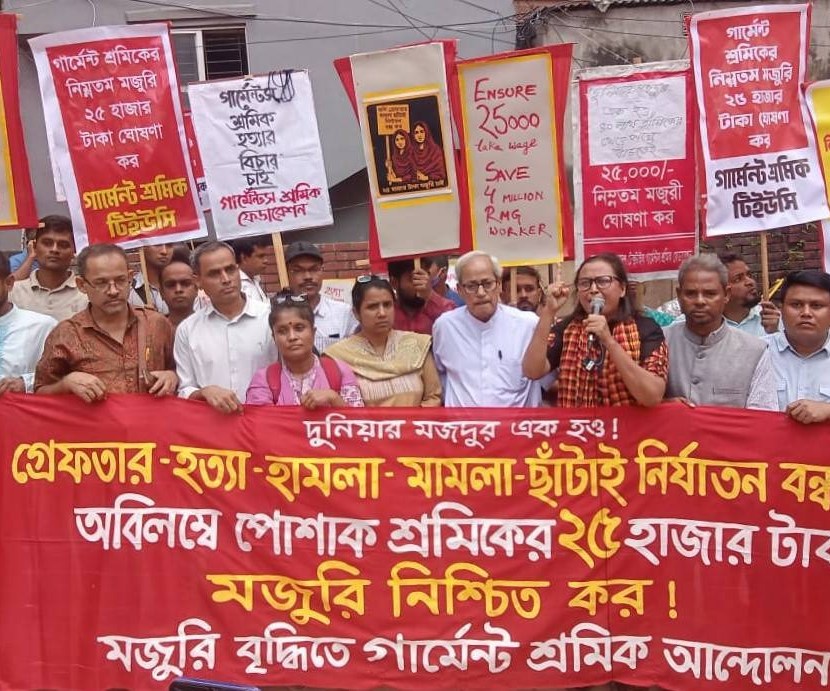
For the past few months garment workers in various parts of Bangladesh took to the streets in their struggle for a proper increase in basic minimum wage. Up until December 2023 garment workers received a minimum wage of 8 000 BDT (73 USD) per month, which was set in 2018. Labour unions demand an increase to at least 23 000 BDT, the Garment Workers’ Trade Union Center (GWTUC) fights for a minimum wage of 25 000 BDT. On November 7th, following a week of intense strikes, blockades and street protests, the wage board announced an increase of the minimum wage to 12 500 BDT, effective from December 2023. Unions reject this decision and announced to continue the fight for a proper living wage. Workers – especially with families – are unable to survive with a monthly income of 12 500 BDT (113 USD) only.
Consequently the GWTUC calls on unions and fellow workers worldwide to support the fighting garment workers in their struggle. Confrontations inside the factories and on the streets are intense. Five workers already lost their lives, some of whom were shot dead by police.
Check out the call below or download the pdf.
Not only factory owners but also the brands sourcing from those factories are major profiteers of the workers’ sweat and labour. The products end up in stores worldwide. Therefore: Let’s globalise this fight, take it to the streets and confront the brands!
Note: Some brands released a statement directed at the president of Bangladesh asking for the conflict to be resolved as soon as possible. But statements are not enough. The retailers must ensure that the factories they source from pay a minimum wage of 25 000 BDT!
This NEWS section provides updates on the movement continuously.


CONTACT
To announce or share reports on your actions, drop a line at: garmentworkerssolidarity@globalmayday.net | globalmayday@lists.riseup.net (mailing list)
MATERIALS
Download the leaflet (A5) as a pdf.


Dhaka: Garment workers take to the streets for 25 000 BDT minimum wage!
Garment workers of various factories rallied in front of the National Press Club in Dhaka (Bangladesh) on September 29th. This protest was called by the Garment Workers’ Trade Union Center (GWTUC) and kicked off the struggle for 25 000 BDT minimum monthly wage on the streets! Though 25 000 BDT don’t even equal 215 EUR (227 US$), this fight is essential to every single factory worker.
In 2018 the minimum wage was increased the last time. Since then workers have to get along with a meagre 8 000 BDT minimum wage. Since then also many people in Bangladesh suffered under an enormous inflation rate. Especially lower wage workers hardly get along.
Therefore GWTUC, which unites hundreds of thousands of garment workers across the country, fights for an increase in wages for garment workers of more than 200%!


Look out for a call of international solidarity in the future.
media report: newagebd.net

Express solidarity with feminist movement in Bangladesh
Lately thousands of people have been taking to the streets against sexualized violence in Bangladesh. The movement was triggered by numerous gang rapes that had taken place throughout the country last month. The protests are not only directed against these blatant incidents, but they aim at changing society as a whole putting sexism in its many forms on the table.
Two weeks ago a Long March organized by organisations like the Bangladesh Student Union (BSU), Garment Workers’ Trade Union Center (GWTUC), the anarchist network Auraj as well other feminist groups was brutally attacked by ruling party cadres and police. Since then the protests continued and so did the attacks by reactionary forces.
The feminist movement calls on the international community to express their support. On one hand it will help to raise awareness about those developments in Bangladesh and on the other hand it will help activists on the ground struggling with attacks on various levels.
One way of expressing your solidarity is by taking a picture of yourself holding a sign with your personal message and send it to globalmaydaynetwork@gmail.com.


Submitted pictures will be published here and forwarded to activists involved in the movement, which will then also share them on social media channels and by doing so reach many more people directly involved in the movement.
Here is a suggested frame, which can be used freely:
(download .pdf / online editable .pdf to display on tablets)

This call was initiated by individuals organized with the Free Workers’ Union (FAU) Hamburg, Industrial Workers of the World (IWW) Hamburg as well as the Garment Workers’ Trade Union Center (GWTUC) in Bangladesh and the Banglaesh Students’ Union (BSU).

Solidarity from Bristol to Dhaka
In reaction to the call for Solidarity submitted by the Garment Workers’ Trade Union Center (GWTUC) the Industrial Workers of the World (IWW) in Bristol held pickets on three different days in front of stores belonging to Primark, H&M and Next. Beforehand they also announced the pickets on the website.


The Free Workers’ Union (FAU) Hamburg plans for a solidarity picket on Friday!
Bangladesh: GWTUC Rallies
The Garment Workers’ Trade Union Center (GWTUC) supports the call for a Global May Day as well and called for rallies in 13 different local areas with garment factories – many of them in Dhaka. The other rallies took place in Narayongonj, Gazipur, Chittagong, Ashulia, Tejgone, Fotulla, Kachpur, Uttara and Rampura. In addition one main rally in Central Dhaka was attended by around 1,000 workers. At the local rallies around 5,000 people gathered.
In their struggle for better working conditions garment workers clashed with riot cops in some of these areas in January 2019.
No incidents with the police were reported this time.
Central Dhaka


Ashulia Industrial Area


Tejgaon Industrial Area


Kachpur Industrial Area


Fotulla Industrial Area


